
Before You Talk to a Broker, Check Your Readiness First
An owner picks
up the phone, calls a broker, and treats that call as the first real step
toward selling. It feels like progress. It isn't. Not yet. The call is really a decision about going to market, and that decision makes more sense once you understand what you're actually bringing to market.
Here's the collapse that happens constantly: an owner conflates "getting ready to sell" with "hiring someone to sell it." These are two different jobs, done in the wrong order more often than not, and the sequencing mistake has consequences that show up months later: in a listing that sits, in buyer questions the owner can't answer cleanly, in a broker who quietly stops returning calls once the deal proves harder than the pitch implied.
The first serious step is
readiness, not representation
Before you
evaluate a broker's pitch, evaluate your own situation. What do you actually
need from a sale: emotionally, financially, operationally? What condition is
your business really in, separate from how you feel about it on a good quarter?
This isn't a
stall tactic or a way to avoid the market. It's the difference between walking
into a broker conversation with clear terms of engagement and walking in hoping
the broker will tell you what you're worth and what you need. One of those
postures gets you a productive relationship. The other gets you sold a story.
Preparation and
representation can overlap. A capable advisor can help diagnose your gaps and
prioritize the work, and an early conversation isn't a mistake. The point isn't
to complete every fix in isolation before anyone else is involved. The point is
role clarity: know what you're solving for before you hand the solving to
someone else.

Check whether you are
personally ready to sell
Before price, before process, before broker fees, ask yourself three things. Why are you selling? What will you do the day after the sale closes? And what after-tax number do you actually need to walk away and be fine?
Owners skip this step constantly because it can feel less important than the "real" work of financials and buyer lists. It isn't. It's foundational. A broker
conversation about price range and timeline is meaningless if you haven't
decided what number makes the sale worth doing, net of taxes, net of deal
structure, net of whatever earnout or seller-note terms get proposed later. If
you don't know your number, you'll negotiate against yourself, or worse, you'll
accept the first offer that clears some vague internal bar you never actually
set.
Check whether the business can withstand buyer scrutiny
This is where
most owners discover the gap between "profitable" and "ready."
A business can throw off strong cash flow and still fail a buyer-readiness
check on nearly every other dimension.
Start with the
financials. Are your profit-and-loss statements, asset schedules, and payroll
summaries organized in a way an outside party (someone with no history with
your business) can actually understand and verify? Strong performance means
little if the records supporting it are inconsistent or require a translator.
Organized financials build buyer confidence and let due diligence move faster;
disorganized ones invite suspicion regardless of how good the underlying
numbers are.
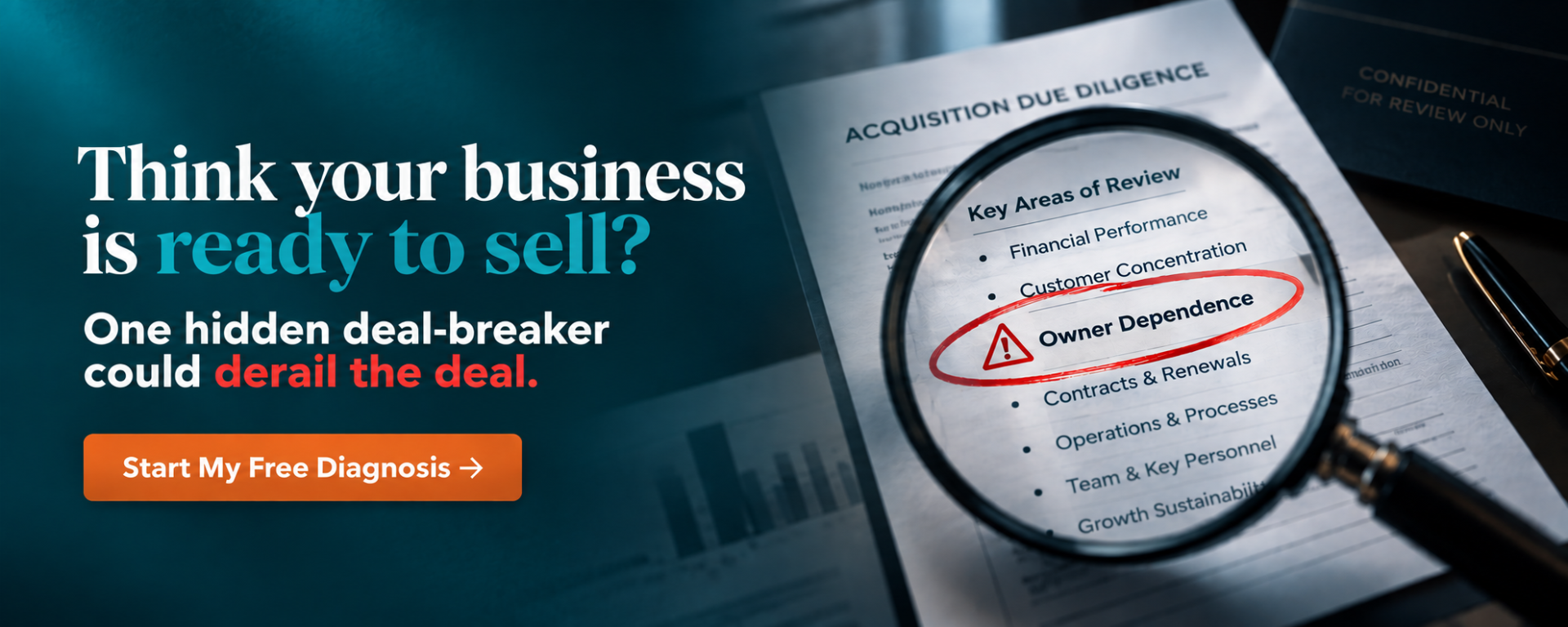
Then look at
process. Is customer onboarding documented? Sales process? Employee training,
vendor management, daily operations, quality control? If the answer to most of
these is "it's in my head" or "Sarah handles that," you
have a documentation gap that becomes an owner-dependency problem the moment a
buyer asks who runs things when you're not there.
Check your
customer base for concentration risk and health. Be ready to explain clearly,
not defensively, why you're selling and what growth opportunities exist for a
new owner. And be honest about unresolved legal, regulatory, or compliance
issues. These don't go away because you didn't mention them; they surface in diligence,
usually at the worst possible moment in the process, and they cost you leverage
precisely when you need it most.

Know what representation is
supposed to do
None of the
above is a broker's job. Once you're actually ready for the market, a broker or
M&A advisor takes on work that's genuinely separate from preparation:
managing buyer outreach, structuring a competitive process, screening who gets
access to your confidential information, and protecting your negotiating
position as the deal moves forward.
Prepare to interview
brokers rather than simply meet them
Once you've
done the readiness work, the broker conversation changes shape entirely. You're
no longer asking "will you take my listing?" You're running a
structured interview, and you should treat it that way.
Build your
shortlist first: through referrals from your attorney or accountant who've
closed deals recently, through direct research (treat a polished website as
marketing, not evidence, and look instead for actual closed transactions and seller
references, not just buyer testimonials), or through professional directories
that list credentialed brokers. Credentials like CBI or M&AMI designations
are a reasonable baseline filter. They indicate some training and continuing
education, but they don't guarantee fit, buyer access, or results. Treat them
as a floor, not a verdict.
Then interview
every candidate on the shortlist against the same criteria. Ask about their
relevant experience in your industry and at your transaction size. A broker who's
great at $2M deals may be the wrong fit at $15M, and vice versa. Ask them to
walk you through the actual marketing process: how a Confidential Information
Memorandum gets built, how buyers get identified and contacted, how many
strategic versus financial buyers they'll target in the first sixty days, and
how they manage confidentiality once conversations start. Vague answers here
("we cast a wide net") are a signal, not a reassurance.
Ask how they
screen buyers before sharing sensitive information, and ask for references from
sellers they've represented recently, not just a logo wall. Get clarity on fee
structure and who pays it. Ask directly about conflicts of interest. And ask
who on their team will actually run your deal; the person pitching you in the
first meeting is not always the person doing the work.
Choose the next step based on the gaps you find
If you've
worked through your personal number, your business's readiness across
financials, process, and risk, and you're not finding major gaps, you're in a
legitimate position to run structured broker interviews now. That's not
premature. That's sequencing done right.
If you found
gaps (messy books, undocumented processes, a compliance issue you'd been
ignoring, no real answer for what you'd do after the sale), the responsible
move isn't to abandon the idea of selling. It's to close those gaps first, or
to get diagnostic help in prioritizing which ones matter most before you're
standing in front of a buyer explaining them for the first time.
Either outcome
is useful information. Neither is a verdict on whether your business is
sellable, only on whether it's ready to be shown.
Ralph Robinson
Ralph Robinson is an experienced business owner and founder of Exit Mastery Blueprint. His perspective is shaped by buyer-side experience evaluating businesses, making offers, and walking away when deals did not hold up under scrutiny. He also brings over 20 years of experience operating owner-led service businesses.
Quick links
Get in touch with us
Email us